


Osteochondrosis is a disease of the spine, which involves dystrophic and degenerative processes in the intervertebral discs.To treat this disease, not only medications are prescribed, but also physiotherapy.Exercises for cervical osteochondrosis can reduce pain and improve the patient's overall well-being.
What influences the development of the disease?
The main factor provoking spinal chondrosis is uneven load.It occurs as a result of sleeping on a soft mattress, awkward sitting position, or wearing anatomically incorrect shoes.Additional factors that activate the pathological process include the following:

- overweight;
- insufficient physical activity;
- physical stress;
- genetic predisposition;
- age-related changes in the musculoskeletal system;
- violation of metabolic processes;
- pregnancy;
- prolonged and frequent dehydration of the body.
All these factors have a negative impact not only on the state of the musculoskeletal system, but also on the body as a whole.
Symptoms of the disease
The symptoms of osteochondrosis can be varied.It depends on the location of the injury.
- When the cervical spine is affecteddizziness, numbness in the hands and tongue, decreased vision and severe headaches are observed.
- Thoracic type of osteochondrosisaccompanied by pain in the ribs and sternum region.
- For low back injuriesDiscomfort is present in the lower back and numbness is observed in the lower extremities.
Indications for exercise therapy
Therapeutic exercises can not only alleviate the symptoms of cervical osteochondrosis, but also prevent further relapses of the disease.

The importance of physical activity
Exercise therapy has no gender or age restrictions.Indications for attending health classes:
- presence of muscle spasm;
- pain;
- weak muscular corset.
Such training will help not only combat degenerative-dystrophic changes in the spine, but also improve the patient's general condition.Physical education will give you strength and vigor.
The benefits of physical therapy
If treatment of the disease was started at the initial stage, physiotherapy can not only relieve pain, but also eliminate the disease.
The analgesic effect is achieved due to the fact that exercise helps restore normal muscle tone.
When performed correctly, this exercise can reduce pressure on nerve endings.
What is needed for training?
Fitness kits may be required for classes.These are soft mats, rollers and sticks.For hand and foot exercises you will need tables.These are special tables with several sections that can be adjusted in height.Externally, they look more like a simulator than a regular table.They are designed for exercises lying down or sitting at different angles.
Depending on the exercises performed, you may need:
- handles;
- tires;
- cuffs;
- roller carts.
The first three items are necessary for joint gymnastics.Roller carts are designed for patients who cannot fully support their limbs.
In some cases, when performing exercises for the back and neck with osteochondrosis, a gymnastic stick is used.
Exercise therapy techniques
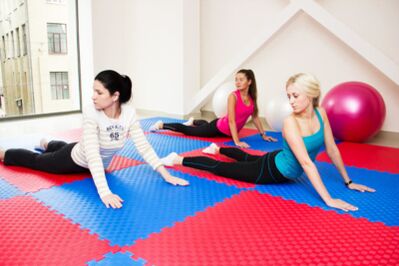
A doctor or trainer will help you choose the most effective training method for osteochondrosis.The specialist must also familiarize the patient with basic safety rules.
There are a large number of different methods for carrying out exercise therapy for osteochondrosis..Passive traction is the most used.It is performed under the pressure of one's own weight.The duration of training varies depending on the patient's condition.It can last from 5 to 20 minutes.If necessary, additional weight can be added to provide traction.
Therapeutic gymnastics involves breathing, general strengthening and special exercises.It is necessary to start training with minimum loads and small amplitude.
Methods for restoring the upper part of the spine
There are many exercises and techniques that allow you to restore the spine.You can study in a group in a special center or at home.
Carrying home
Exercise at home helps not only eliminate pain, but also prevent it.Before doing this, you should consult a doctor or trainer.A positive effect will be observed only with correct technique and regular training.
Any activity should begin with a light warm-up.If there is no pain, you can stretch your knee and ankle joints.Various squats and body twists are recommended.
It is recommended to train in comfortable clothing that does not hinder movement.It is desirable that it be made from natural fabrics that are pleasant to the touch.

Simple turns and inclines
Twists and turns are two of the simplest and most effective exercises..Therapeutic effect:
- pain relief;
- relieve stress from the cervical vertebrae;
- improving spinal mobility.
It's best to start with repetitions and then gradually move to inclines.It is recommended to do each exercise 10 times.
Axial rotation
With the help of axial rotation, you can stretch your neck muscles well and improve their elasticity.Exercise activates blood flow through vessels.It will be especially useful for people with sedentary work.During the working day, you need to do 2-3 sets of this exercise.
Leaning Tower
In the “leaning tower” exercise you need to be as careful as possible.
- Starting position – standing.
- Your legs should be apart, your shoulders should be down, and your chin should be up.During the exercise, your shoulders should be as relaxed as possible.
- You need to move your body and shoulders back for 5 to 8 counts while your head remains in place.
- Return to the starting position as smoothly as possible.
- The ideal number of repetitions is 8 times.
Strength Stretch
Thisexercise aims to stretch muscles and increase their elasticity.It will also help relieve compression from tight muscles.
It is recommended that this stretch be done under the supervision of a trainer.
Any incorrect movement can cause displacement of the cervical vertebrae and injury.
Algorithm:
- When leaning to the right, you should try to touch your earlobe to your right shoulder.
- It is necessary to fix the posture for 5 to 10 seconds.
- The left hand rests on the head and makes several jumping movements.
- Similar movements are performed on the second side.
Before starting your workout, you need to warm up your muscles well.Otherwise, you could injure ligaments and tendons.
Stretch with a towel

In terms of technique, towel exercises are similar to effortful stretching.Allows you to stretch the muscles that support the cervical vertebrae.A terry towel folded several times is used as a charge amplifier.
The exercise is done as follows:
- The towel is rolled up and held with both hands at a distance of 30-35 cm from each other.
- You need to bring the towel behind your head and place it behind the back of your neck.
- When pulling the towel up, your neck muscles should not offer resistance.To achieve this, you can tilt your head back a little.
The ideal number of repetitions is 8 to 10 times.If you do the exercise correctly, you can quickly get rid of muscle spasms and pain.
Gentle neck complexes
There are special gentle complexes that allow you to keep your neck muscles in good shape.It is necessary to perform such exercises only in the period between exacerbations.
Algorithm for the first exercise:
- The starting position is standing, arms down, straight posture.
- Slowly you need to move your head 90 degrees.At first, the amplitude should be minimal;as the patient's condition improves, head rotation can be increased to 90 degrees.
- Similar movements are performed on the second side.
If you turn too quickly, you risk dislocating your vertebrae.The number of repetitions can vary from 7 to 10 times in each direction.
To perform the second exercise, you must remain in the same starting position - standing upright and with your back straight.You need to gently lower your head and try to touch your chin to your chest.If this is not possible, you should perform the exercise as much as possible.
Gentle gymnastics for osteochondrosis involves smooth, slow movements.They should not cause serious discomfort.
Carrying by the neck
Training of a doctor of medical sciences
The doctor has developed a series of exercises that will help alleviate the condition of a patient with cervical osteochondrosis and are suitable for performing at home.They will be an excellent disease prevention.
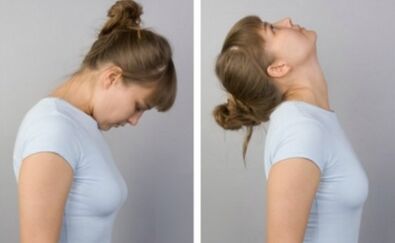
- "Spring" For the exercise, you can choose the most comfortable starting position. You need to start by slowly tilting your head. You should gently move to stretch your neck upward. It is recommended to repeat these movements 5 more times.
- "Metronome" This exercise is performed while sitting on a chair with your back straight. You need to tilt your head to the side and maintain this position for 30 seconds. The same is done on the second side.
- "Analysis". You need to tilt your head a little and fix the position. In this position, you should turn your head in different directions 5 times in each direction.
- "Goose". This exercise is aimed at eliminating double chin and improving blood circulation. You need to sit up straight and straighten your shoulders. When inhaling, the chin is pulled forward as much as possible; after 3 seconds it should be pressed against the shoulder.
You need to keep your head in this position for another 12 seconds and then return to the starting position.5 repetitions must be performed on each side.
- "heron" To perform the exercise, you need to straighten your back as much as possible and place your hands on your knees. After that, they are retracted behind your back, while your chin rises. This exercise involves the cervical and thoracic spine.
- "Difficult review"The left hand should be placed on the right shoulder, while the head turns to the left. You need to stay in this position for 30 seconds. Similar movements are performed on the second side.
- "Fakir" Initial posture – arms raised. They need to be connected and gently rotate the head in different directions. You need to lock in each position for a few seconds.
Complex of a reflexologist
You can perform the complex for the treatment of HSC only if you feel well.The first few exercises may cause slight dizziness.Possible crunching or crunching in the neck.
While performing the exercises, your shoulders must remain motionless.
Initially, you need to perform a neck flexibility test – you should try to tilt your head to touch your chin to your chest.If you only managed to complete the task halfway, this indicates poor flexibility in your cervical spine.
Training must be done every day.You need to start with slight turns and tilts of the head.It is important not to sit too tensely in a fixed position.This exercise is perfect for warming up your neck after working at the computer for a long time.
Photo
Below you will see different exercises in photos for the treatment of cervical osteochondrosis:
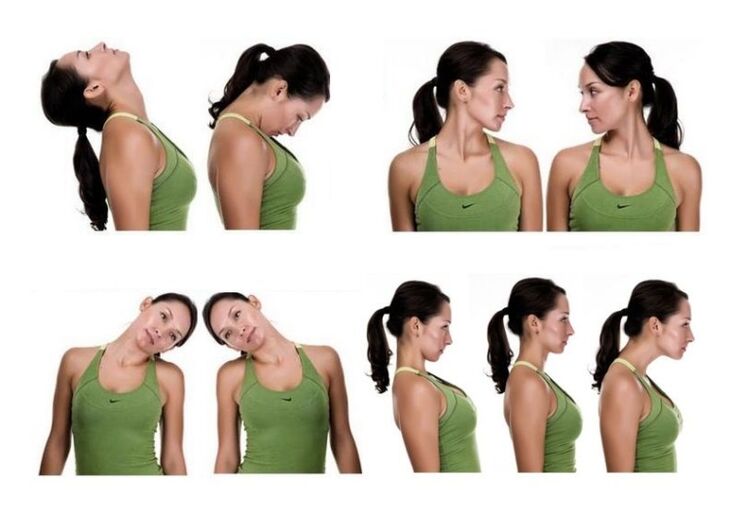

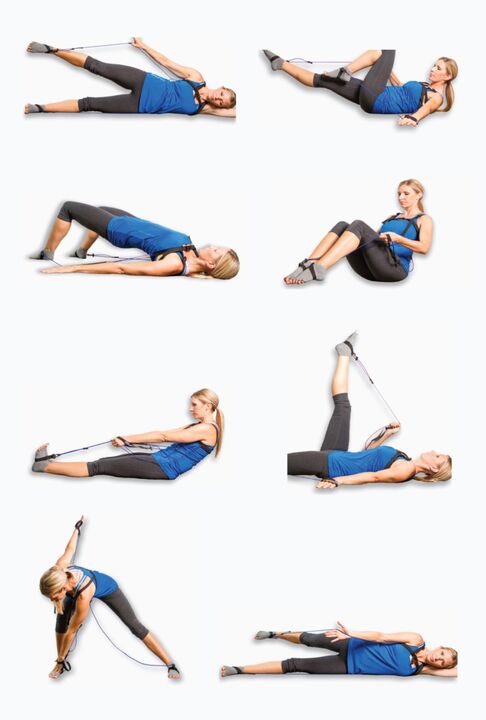
In addition to series of physical therapy exercises, regular yoga classes can help deal with SCH.
How to increase the effectiveness of classes?
An integrated approach will increase training effectiveness.It is important that classes are regular and that the exercise technique is correct.
What should the treatment be combined with?
Comprehensive treatment includes not only exercise, but also proper nutrition.
The patient must:
- lead a correct lifestyle;
- harden;
- periodically undergo preventive massage courses.
Food
The diet of a person with osteochondrosis must contain all the vitamins and nutrients necessary to restore damaged tissues.Water-salt balance plays an important role.It is recommended to drink plenty of fluids.
The ideal amount of water depends on age and severity of the disease.
If necessary, the doctor prescribes a special diet.Its essence is fractional nutrition, that is, food should be eaten in small portions 5 to 6 times a day.This eating pattern will allow you to reduce body weight, thus relieving the load on the spine.
Massage
Therapeutic massage for osteochondrosis should be performed by a specialist.Initially, he must make sure that there are no contraindications.The impact on the affected muscles allows you to relieve pain.Therapeutic effect:
- better blood circulation;
- prevention of muscle atrophy;
- restoration of nutrition of soft tissues and discs.
Massage is best combined with physical therapy and exercise therapy.
Contrast shower

It is recommended to take a contrast shower in the morning and evening.If you douse yourself with cold water immediately after waking up, the load on the heart increases, so it is better to take a shower 30-50 minutes after waking up.
To avoid damaging the heart muscle, you should alternate the pressure from 40°C to 20°C.
You should not take a contrast shower after a long stay in the cold, as it is dangerous due to hypothermia.
Gymnastics effect
Therapeutic gymnastics has a positive effect on the entire body.The following therapeutic effect is observed:
- activation of cerebral circulation;
- strengthening chest and neck muscles;
- elimination of headaches and insomnia;
- alleviate the symptoms of cervical osteochondrosis.
Properly performing the exercises will help the patient regain the ability to work.Physiotherapy is an excellent method of preventing spinal diseases.
Relapse prevention
To avoid relapses, you must carefully monitor your diet and exercise.Basic recommendations:

- Carrying out moderate activities.It could be swimming, gymnastics or non-contact wrestling.
- During prolonged sedentary work, it is necessary to take periodic warm-up breaks.They will help restore normal blood circulation.
- It is best to sleep on an orthopedic mattress with a flat surface.You should avoid pillows that are too flat.
- Lifting or carrying heavy objects should be avoided.
- It is necessary to give preference to orthopedic shoes.
It is important to monitor your emotional state.Increased anxiety and stress provoke an antispasmodic reaction.To eliminate it, you need to learn relaxation methods.
Possible consequences and complications
Incorrect or untimely treatment can lead to complications.Against the background of osteochondrosis, the following pathological processes may occur:
- radiculitis;
- intervertebral hernia;
- strokes in the spinal cord;
- kyphosis;
- paralysis of the lower limbs.
Despite the fact that grade 4 osteochondrosis is not accompanied by active symptoms, it is the most dangerous.The occurrence of complications at this stage can lead to disability.
Useful tips and tricks
Doctors emphasize that at the initial stage cervical osteochondrosis is practically invisible and does not cause much discomfort.At this stage, treatment can only be carried out with the help of exercise therapy.It is necessary to reconsider nutrition.

Experts indicate thatThe best prevention of cervical osteochondrosis is an active lifestyle.
You must completely stop smoking.It is recommended to monitor your posture, especially when sitting for a long time or remaining in the same position.In severe forms of cervical osteochondrosis, special corsets and more active drug therapy are prescribed.
Cervical osteochondrosis reduces a person's quality of life.With this disease, a feeling of stiffness and pain occurs.To improve the condition and prevent complications, it is recommended to perform special therapeutic exercises.